1099 threshold monitoring
The withholding was yours to make. It still is.
WithholdWatch tells a small business which of its contractors have already crossed the IRS reporting threshold without a taxpayer number on file — and how much backup withholding was required on what has already been paid.
Free tier: 5 contractors, 1 seat. No card.
- February invoice$900.00$900.00
- $2,000.00 thresholdApril invoice$1,300.00$2,200.00
- June invoice$700.00$2,900.00
- Reportable from the crossing invoice onward
- $2,000.00
- Backup withholding rate
- 24%
Already required
On payments you have made.
$480.00
If your contractor files and pays their own tax, the IRS does not collect this amount from you a second time — you claim that relief on Form 4670, and that relief requires a signed Form 4669 from each contractor, declaring under penalties of perjury where they reported the payment on their own return. What is not relieved is the penalties, the additions to tax and the interest, and those are computed on this figure. This is the number you have to chase a W-9 to make go away.
The product
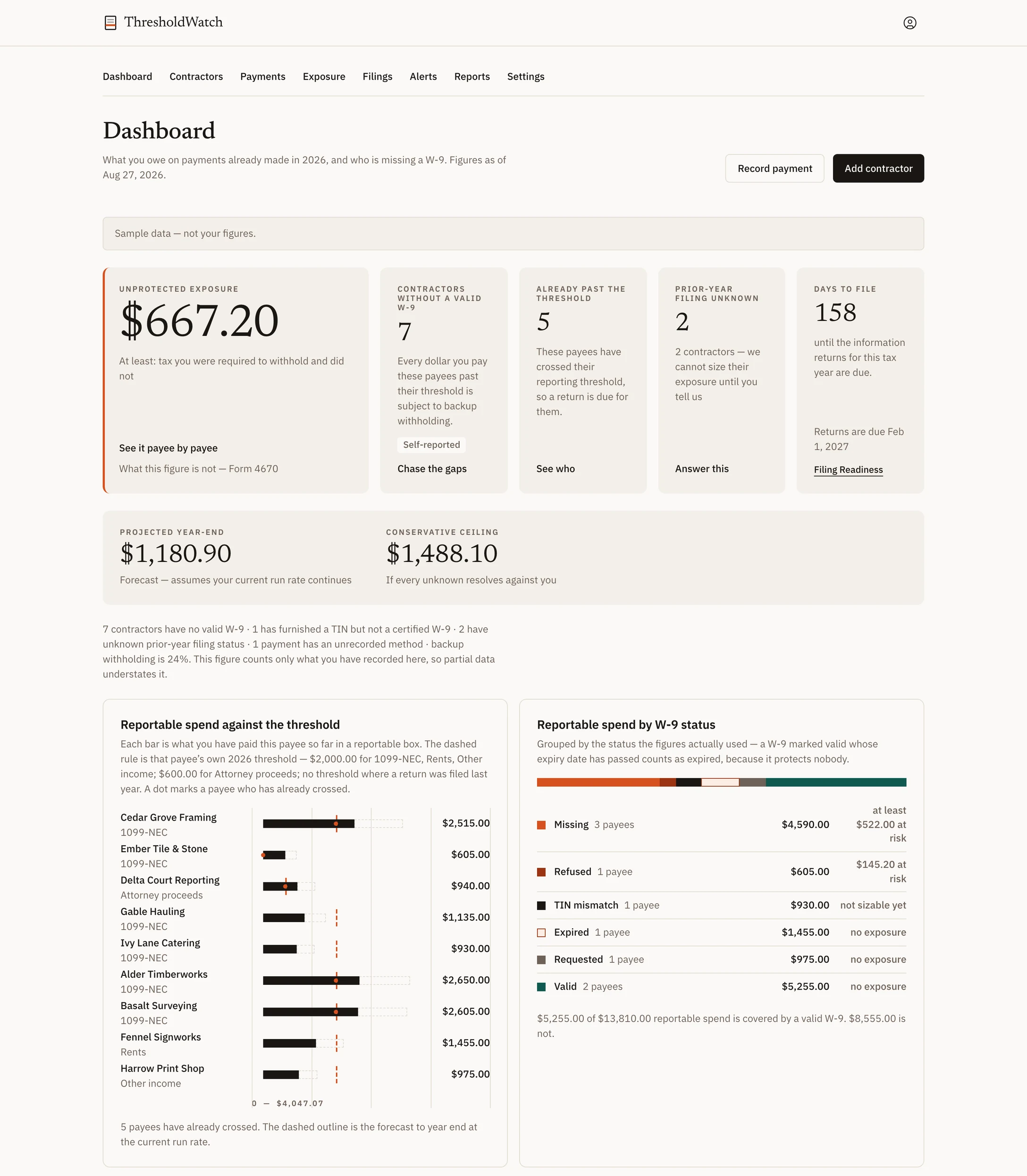
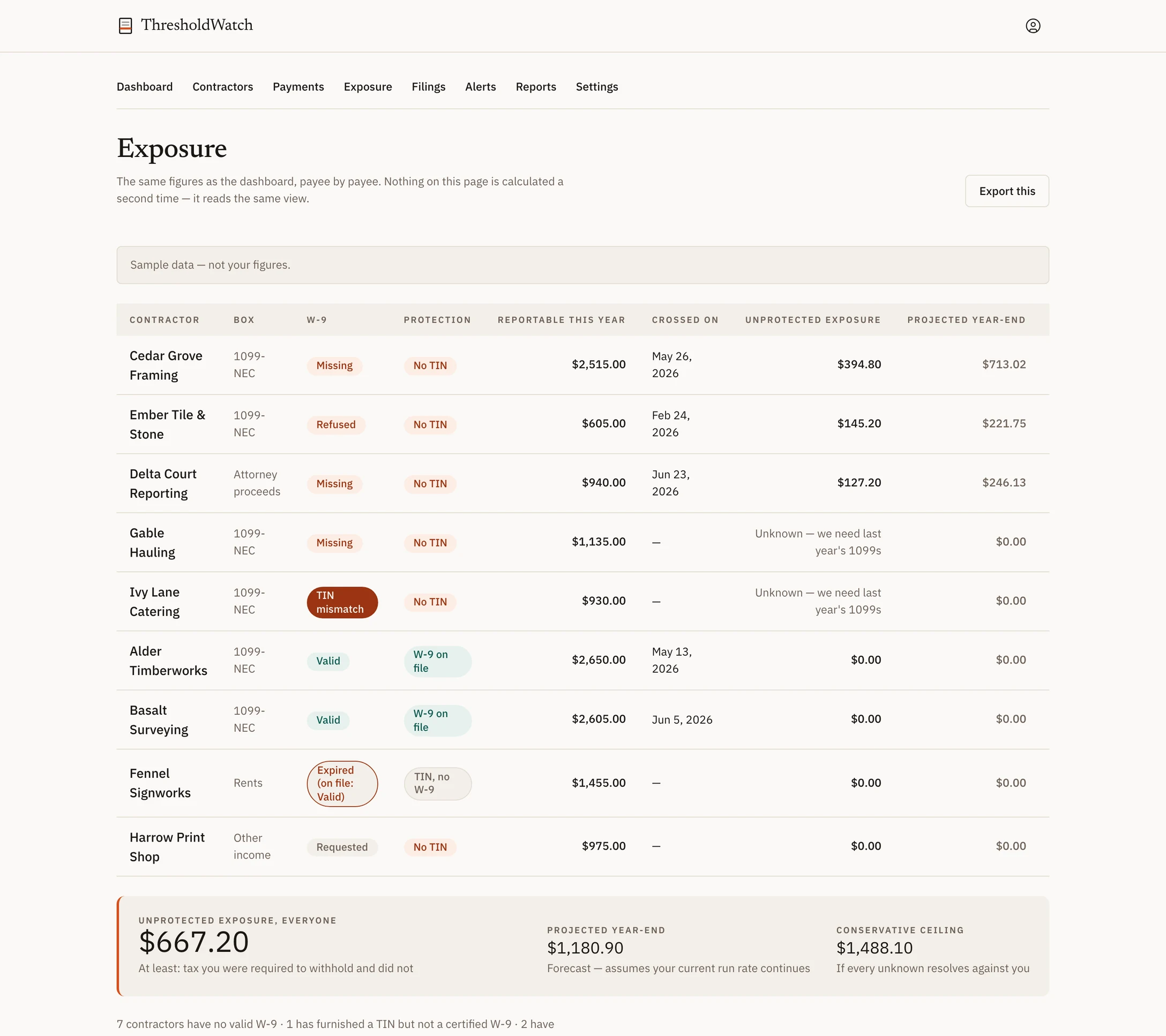
This is the screen you would be looking at.
Both captures are of the running application, loaded against the sample workspace it ships with. The payees, the payments and every dollar figure in them are demo data — no real business, no real contractor, no real taxpayer number.
How it happens
The form is not the problem. The date is.
No single decision here is a mistake. The exposure is built out of three reasonable ones, taken months apart, by someone with a job to finish.

01 — Day one
Nobody collects a W-9 for a $400 job
The first invoice is small, the work is urgent, and the form gets skipped. That is a reasonable decision and it is where the exposure starts.
02 — Mid-year
The threshold is crossed mid-year, quietly
By the fourth or fifth invoice the same payee is reportable. Your ledger knows what you paid. It does not know what you were required to withhold, or from which invoice.
03 — January
You find out in January
At filing time you need a taxpayer number from someone who finished the job in June and has stopped answering. Until then, the withholding was yours to make.
Worked example
How the figure is built
One payee, three invoices, nothing unusual. The threshold is crossed on the second one — and the payment that crosses it is reportable in full, not just the part above the line. That is the difference between a number you can defend and a number that is too small.
See the whole calculation| Invoice | Amount | Running total | Reportable |
|---|---|---|---|
| February invoice | $900.00 | $900.00 | — |
$2,000.00 threshold | |||
| April invoice | $1,300.00 | $2,200.00 | $1,300.00 |
| June invoice | $700.00 | $2,900.00 | $700.00 |
- Reportable from the crossing invoice onward
- $2,000.00
- At 24%, already required
- $480.00
Amounts derived from the 2026 figures WithholdWatch reads from its own threshold table. Illustrative — not your figures.
The six
What you get
Six things, named the same way everywhere in the product and on every invoice. Four of them are in the first release. The two that are not say so here, on the pricing page and inside the product, rather than being discovered later.
Exposure Monitor
The dollar figure you are already required to have withheld, per contractor and for the whole team.
W-9 Vault
Every contractor’s W-9 status, when it was received, when it goes stale, and who you have chased.
Threshold Ledger
The published IRS threshold for each reporting box and tax year, with the statute it comes from.
Crossing Alerts
In developmentA message before a payee crosses, on the day they cross, and when a W-9 you hold expires.
Payment Import
Bring a CSV of contractors or payments, map the columns, see what will happen, then commit it.
Filing Readiness
For each tax year: how many returns you owe, the computed deadline, and what is blocking you.
Stated limits
What WithholdWatch will not do
Written down before the sale rather than discovered after it. Each of these is a thing the product could plausibly be expected to do, and does not — on purpose.
01
It will not tell you whether someone is an employee
Worker classification is a legal judgement with real consequences, and no field, export or screen in this product hints at an answer. WithholdWatch reports payments against published thresholds and stops there.
02
It will not estimate a figure the IRS has not published
Where a threshold or a rate is unpublished, the screen says so in words. It never shows a zero, and it never quietly carries last year’s number forward.
03
It will not show a full taxpayer number
WithholdWatch stores and displays the last four digits. If you paste a full number into an import, the row is rejected at the preview rather than stored and then hidden.
04
It cannot see payments you have not given it
Every figure is a floor computed from what you have entered or imported. Partial data understates, always in that direction, and the product says so on the screen rather than in a footnote.
Pricing
Three plans. The first is free and stays free.
- Free
$0
5 contractors, 1 seat.
- Core
$29/month
50 contractors, 3 seats.
- Firm
$199/month
Unlimited contractors, Unlimited seats.
Find out today, not in January.
Add the contractors you have paid this year. WithholdWatch tells you who is already over the line and what that is worth, before the form is impossible to get.
No card · 5 contractors · 1 seat